


Fixed vs Floating Home Loan Interest Rate – Which is Better in 2026?
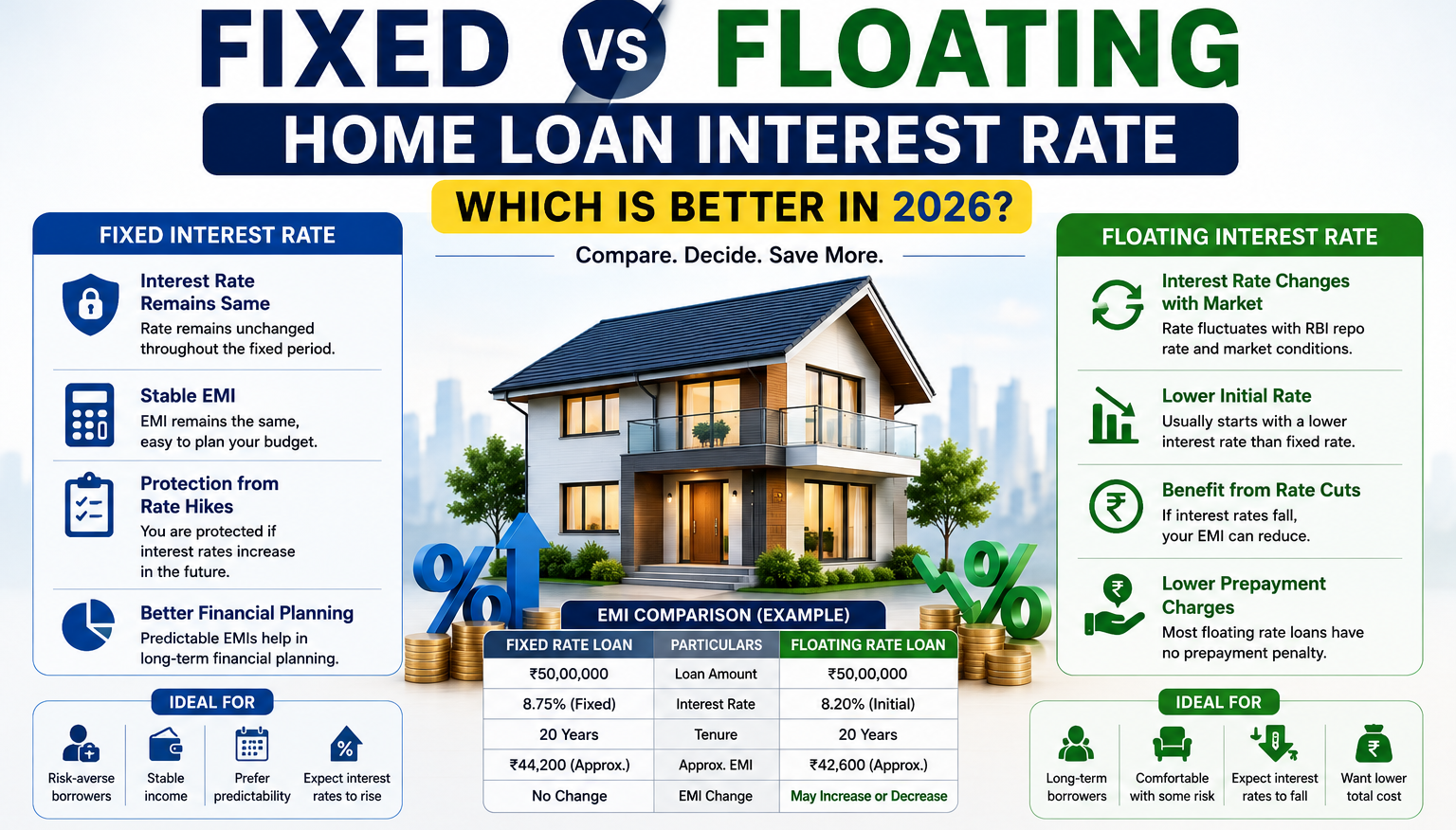
Fixed vs Floating Home Loan Interest Rate – Which is Better in 2026?
When applying for a home loan, understanding the interest rate is one of the most important factors. Many borrowers assume there is only one type of home loan interest rate, but in reality, there are two major options: Fixed vs Floating Home Loan Interest Rate. Choosing the wrong option can impact your monthly EMI and the total cost of your loan. If you’re unsure which one is right for you, this guide will help you understand the key differences, benefits, and drawbacks of both, so you can make an informed decision based on your financial goals
A small difference of even 0.50% in your interest rate can save—or cost—you lakhs of rupees over the life of your loan.
In this comprehensive guide, we’ll explain:
- What is a Fixed Home Loan Interest Rate?
- What is a Floating Home Loan Interest Rate?
- Advantages and Disadvantages of both options
- EMI comparison
- Which option is better in 2026?
- Factors to consider before choosing
- Expert tips for borrowers
Let’s begin.
Understanding Fixed vs Floating Home Loan Interest Rate
Before comparing Fixed vs Floating Home Loan Interest rate, it’s important to understand how home loan interest works.
A home loan interest rate is the percentage charged by the lender on the borrowed amount. Your EMI consists of:
- Principal Amount
- Interest Amount
The interest rate directly affects:
- Monthly EMI
- Loan tenure
- Total repayment amount
- Overall affordability
Most Indian banks and NBFCs offer two major types of interest rates:
- Fixed Interest Rate
- Floating Interest Rate
Let’s understand each in detail.
What is a Fixed Home Loan Interest Rate?
A Fixed Home Loan Interest Rate remains unchanged for a predefined period or throughout the loan tenure, depending on the lender’s policy.
This means your EMI stays the same regardless of changes in market interest rates.
Example
Suppose you take a home loan of:
- Loan Amount: ₹50,00,000
- Interest Rate: 8.50%
- Tenure: 20 Years
Even if RBI reduces or increases repo rates, your EMI generally remains unchanged during the fixed-rate period.
This provides stability and predictability in financial planning.
Features of Fixed Home Loan Interest Rate
- EMI remains constant
- Easier monthly budgeting
- Protection against future interest rate hikes
- Suitable for long-term financial planning
- Limited impact from market fluctuations
- Often available for selected loan tenures
Advantages of Fixed Home Loan Interest Rate
1. Stable Monthly EMI
One of the biggest benefits is that your monthly EMI does not change.
This helps families manage expenses without worrying about rising interest rates.
2. Better Financial Planning
Since your EMI remains fixed, you can easily plan:
- Household budget
- Investments
- Children’s education
- Insurance premiums
- Retirement savings
3. Protection Against Rising Interest Rates
If RBI increases repo rates several times, floating-rate borrowers may see higher EMIs.
Fixed-rate borrowers remain protected during the fixed-rate period.
4. Peace of Mind
Many borrowers prefer certainty over savings.
Knowing your EMI won’t increase provides financial confidence and reduces stress.
5. Suitable During Rising Interest Rate Cycles
If experts expect interest rates to increase significantly, locking in a fixed rate can be a smart move.
Disadvantages of Fixed Home Loan Interest Rate
Higher Initial Interest Rate
Fixed rates are generally 0.50% to 2% higher than floating rates.
Banks charge a premium because they bear the risk of future rate increases.
Limited Benefit When Rates Fall
If RBI reduces repo rates, your EMI usually remains unchanged during the fixed-rate period.
Floating-rate borrowers, however, may enjoy lower EMIs or shorter loan tenures.
Possible Conversion Charges
Some lenders charge fees if you want to switch from a fixed to a floating interest rate later.
Always check the lender’s conversion policy before signing the loan agreement.
Limited Availability
Not every lender offers fixed rates for the full tenure.
Some loans are fixed only for the first 2–5 years and automatically convert to floating thereafter.
What is a Floating Home Loan Interest Rate?
A Floating Home Loan Interest Rate changes according to market conditions and the lender’s benchmark, such as the RBI’s Repo Linked Lending Rate (RLLR) or External Benchmark Lending Rate (EBLR).
When the RBI changes the repo rate, lenders may revise their lending rates, causing your home loan interest rate to increase or decrease.
As a result, either:
- Your EMI changes, or
- Your loan tenure changes while the EMI remains the same (depending on the lender’s policy).
Example
Suppose you take a ₹50 lakh home loan at an initial floating interest rate of 8.20%.
If the RBI reduces interest rates and your lender revises the rate to 7.80%, you may benefit from:
- Lower EMI, or
- Faster loan repayment if the EMI stays unchanged.
Similarly, if rates rise, your EMI or tenure may increase.
Key Features of Floating Interest Rates
- Linked to market conditions
- Influenced by RBI repo rate changes
- EMIs or tenure may change over time
- Usually starts with a lower interest rate than fixed loans
- Suitable for borrowers comfortable with some market fluctuations
- Can result in lower total interest costs if rates decline
Advantages of Floating Home Loan Interest Rate
1. Lower Starting Interest Rate
Floating-rate loans generally begin with a lower interest rate than fixed-rate loans, making them attractive for many borrowers.
2. Benefit from Falling Interest Rates
If lending rates decrease, borrowers can enjoy lower borrowing costs without refinancing the loan.
This can significantly reduce the total interest paid over the loan tenure.
3. Lower Overall Cost (in a Falling Rate Cycle)
During periods of declining interest rates, floating-rate loans often prove more economical than fixed-rate loans.
4. Lower Prepayment Charges
Most floating-rate home loans for individuals have no prepayment penalty, allowing borrowers to make part-payments whenever they have surplus funds.
This flexibility can help reduce both the loan tenure and the total interest burden.
5. Better Long-Term Savings
Historically, floating rates have often been lower than fixed rates over long loan tenures, especially when interest rates soften after periods of increase.
Disadvantages of Floating Interest Rate
- EMI may increase unexpectedly.
- Monthly budgeting becomes less predictable.
- Higher interest rates can increase the overall loan cost.
- Loan tenure may extend if EMIs remain unchanged.
- Borrowers must stay informed about market and RBI policy changes.
Fixed vs Floating Home Loan Interest Rate: Detailed Comparison
| Feature | Fixed Interest Rate | Floating Interest Rate |
|---|---|---|
| Interest Rate | Remains constant (as per lender’s fixed period) | Changes with market conditions |
| EMI | Mostly fixed | May increase or decrease |
| Financial Planning | Easier | Less predictable |
| Initial Interest Rate | Usually higher | Usually lower |
| Benefit if RBI Cuts Rates | No | Yes |
| Protection Against Rate Hikes | Yes | No |
| Best For | Stable income & budgeting | Long-term savings & flexibility |
| Risk Level | Low | Moderate |
| Prepayment Charges | May apply depending on lender | Generally no charges for individual borrowers |
| Suitable Loan Tenure | Short to medium term | Long-term loans |
EMI Comparison: Fixed vs Floating Home Loan Interest Rate
Let’s compare both options with a practical example.
Loan Details
- Loan Amount: ₹50,00,000
- Loan Tenure: 20 Years
Scenario 1 – Fixed Interest Rate
- Interest Rate: 8.75%
- Approximate EMI: ₹44,186
- EMI remains unchanged during the fixed-rate period.
Scenario 2 – Floating Interest Rate
- Initial Interest Rate: 8.20%
- Approximate EMI: ₹42,600
If interest rates fall to 7.80%, your EMI may reduce or your loan tenure may become shorter, depending on your lender.
If rates increase to 9.00%, your EMI or loan tenure could increase.
Key Takeaway: Floating rates may help you save money in a declining interest rate environment, while fixed rates provide certainty.
Factors to Consider Before Choosing
1. Your Income Stability
If you have a stable income and prefer predictable monthly expenses, a fixed rate may suit you better.
If your income is flexible and you can manage occasional EMI changes, a floating rate can be a good option.
2. Market Interest Rate Outlook
If interest rates are expected to rise, locking in a fixed rate may provide protection.
If rates are expected to remain stable or decline, a floating rate may offer long-term savings.
3. Loan Tenure
- Short-term loans (5–10 years): Fixed rates can provide stability.
- Long-term loans (15–30 years): Floating rates often become more cost-effective over time.
4. Risk Appetite
Ask yourself:
- Can I comfortably handle higher EMIs if interest rates increase?
- Do I value predictable payments more than potential savings?
Your answers will help determine the right choice.
5. Future Financial Plans
If you plan to make regular prepayments or close your loan early, floating-rate loans are generally more flexible due to lower or no prepayment charges for individual borrowers.
Which Home Loan Interest Rate is Better in 2026?
There is no one-size-fits-all answer. The right choice depends on your financial goals, income stability, and expectations about future interest rates.
Choose a Fixed Interest Rate If:
- You prefer stable EMIs.
- You have a fixed monthly budget.
- You expect interest rates to increase.
- You don’t want uncertainty in loan repayments.
- You’re buying your first home and value predictability.
Choose a Floating Interest Rate If:
- You want a lower starting interest rate.
- You’re comfortable with some market fluctuations.
- You expect interest rates to decline or remain stable.
- You plan to prepay your loan.
- Your loan tenure is 15 years or more.
Can You Switch Between Fixed and Floating Rates?
Yes. Many banks and NBFCs allow borrowers to convert their loan from fixed to floating or vice versa.
However, before switching, consider:
- Conversion charges
- Revised interest rate
- Remaining loan tenure
- Overall savings after conversion
- Lender-specific terms and conditions
Always calculate the financial impact before making a decision.
What is a Hybrid Home Loan?
Some lenders offer a hybrid home loan, where:
- The interest rate remains fixed for an initial period (for example, the first 2–5 years).
- After that, it automatically converts to a floating rate.
Benefits of Hybrid Loans
- Initial EMI stability
- Opportunity to benefit from future rate reductions
- Balanced approach between security and flexibility
Common Mistakes to Avoid
Choosing Only Based on the Lowest Interest Rate
A lower initial rate does not always mean a lower overall loan cost.
Ignoring Processing and Conversion Charges
Compare all loan-related costs, not just the interest rate.
Not Reading the Loan Agreement
Understand clauses related to interest rate revisions, conversions, prepayments, and foreclosure.
Not Comparing Multiple Lenders
Compare offers from several banks and NBFCs before making a decision.
Ignoring Your Financial Goals
Choose the option that matches your income, lifestyle, and long-term plans—not just today’s lowest EMI.
Expert Tips Before Applying for a Home Loan
- Compare interest rates from multiple lenders.
- Check your credit score before applying.
- Maintain a healthy debt-to-income ratio.
- Read all loan terms carefully.
- Use a home loan EMI calculator before finalizing your loan.
- Keep an emergency fund to manage unexpected EMI increases.
- Review your loan periodically and consider refinancing if it offers meaningful savings.
Frequently Asked Questions (FAQs)
1. Is a fixed home loan interest rate completely fixed?
Not always. Some lenders offer fixed rates only for a specified period, after which the loan may convert to a floating rate.
2. Which is cheaper in the long run?
In many cases, floating-rate loans can be cheaper over a long tenure if interest rates remain stable or decrease. However, future rate movements cannot be guaranteed.
3. Can I switch from a floating to a fixed rate later?
Yes. Many lenders allow this, subject to their policies and applicable conversion charges.
4. Which option is better for first-time home buyers?
If you value certainty and easy budgeting, a fixed rate may be suitable. If you’re comfortable with changing EMIs and want the possibility of long-term savings, a floating rate may be a better fit.
5. Does RBI policy affect fixed-rate loans?
Floating-rate loans are directly influenced by changes in benchmark lending rates. Fixed-rate loans generally remain unaffected during their fixed-rate period.
Final Verdict
Both fixed and floating home loan interest rates have their own advantages.
If your priority is financial stability and predictable EMIs, a fixed-rate home loan can provide peace of mind.
If your goal is long-term savings and flexibility, and you’re comfortable with changing interest rates, a floating-rate home loan may be more suitable.
Before making your decision:
- Compare multiple lenders.
- Evaluate your financial situation.
- Understand the terms and conditions.
- Choose the option that aligns with your long-term goals.
A well-informed decision today can help you save a significant amount over the life of your home loan.
Conclusion
Choosing between a Fixed vs Floating Home Loan Interest Rate is about more than just the current interest rate—it’s about your financial priorities, repayment capacity, and future plans.
Take time to compare lenders, understand the loan structure, and seek professional guidance if needed. Making the right choice today can improve your financial stability for years to come.
Disclaimer: The information provided in this article is for educational and informational purposes only. Home loan eligibility, interest rates, loan amount, and approval criteria may vary depending on the lender’s policies, RBI guidelines, applicant profile, credit score, income, and other factors. Please consult your bank, financial institution, or a qualified financial advisor before making any home loan decision. This article does not constitute financial or legal advice.
Latest Blogs
- Loan Against Property vs. Secured Business Loan in (2026): Interest Rates, Eligibility, Costs & Which Is Better?
- RBI Repo Rate Hike 2026: How Will It Affect Your Home Loan EMI? 7 Ways to Protect Your Budget
- Home Loan for Unauthorised Colony Property in Delhi NCR (2026): Eligibility, Documents, Loan Options & How to Apply”
- Home Loan for GPA Property in Delhi NCR (2026): Eligibility, Documents, Banks & Alternatives
- Home Loan for Property Without Registry in Delhi NCR (2026): Is It Possible?