


Home Loan Documents Required in 2026 – Complete Checklist for Salaried & Self-Employed Borrowers
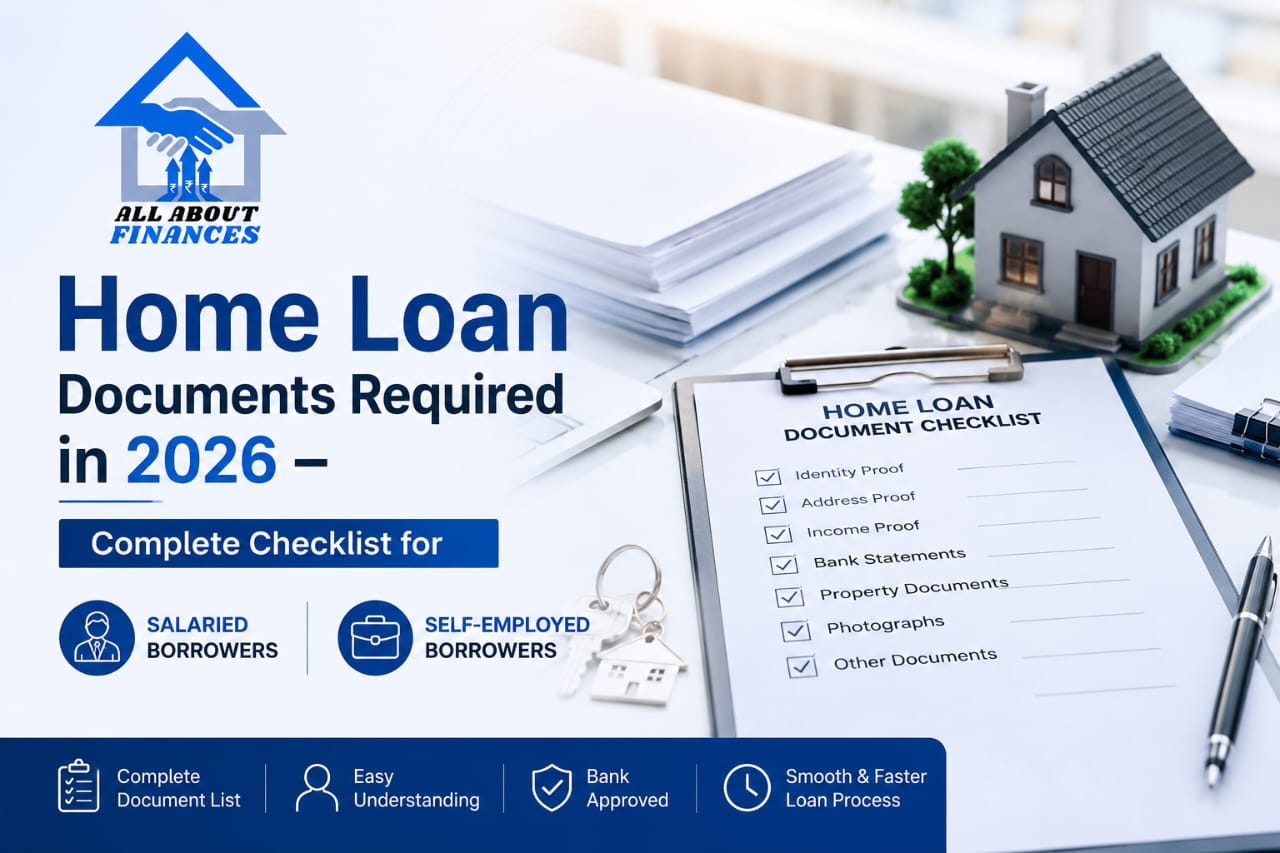
Home Loan Documents Required in 2026 – Complete Checklist for Salaried & Self-Employed Borrowers
Before applying for a home loan, it is essential to know which documents are required. we provide a complete guide to Home Loan Documents Required in 2026, including a detailed checklist for both salaried and self-employed borrowers.
Many applicants face unnecessary delays simply because they forget an important document or submit outdated paperwork.
This comprehensive guide covers all the Home Hoan Documents Required in 2026, including separate checklists for salaried employees, self-employed individuals, property documents, KYC requirements, bank statements, common mistakes, FAQs, and a downloadable checklist.
By the end of this guide, you’ll know exactly what to keep ready before applying for your home loan.
Why Are Home Loan Documents Important?
Banks and NBFCs verify documents to evaluate:
- Identity verification
- Address verification
- Income stability
- Employment or business continuity
- Creditworthiness
- Property ownership
- Legal status of the property
- Loan repayment capability
Submitting complete and accurate documents increases your chances of faster approval.
Home Loan Documents Required in (2026)
Here’s a quick overview.
| Document Type | Required |
|---|---|
| Identity Proof | ✅ |
| Address Proof | ✅ |
| PAN Card | ✅ |
| Aadhaar Card | ✅ |
| Passport Size Photos | ✅ |
| Salary Slips | For Salaried employed |
| Income Tax Returns | For Self-employed |
| Bank Statements | ✅ |
| Property Documents | ✅ |
| Employment Proof | For Salaried employed |
| Business Proof | For Self-employed |
| Form 16 | For Salaried employed |
| GST Registration | For Self-employed |
However, even if all the required documents are not available, some NBFCs in the market may still provide a loan, subject to their internal policies and the flexibility of their lending criteria.
Documents Required for Salaried Applicants
If you’re employed in a private company, government department, PSU, MNC, or public organization, you’ll generally need the following documents.
1. Identity Proof
Any one of the following:
- Aadhaar Card
- PAN Card
- Voter ID
2. Address Proof
Banks accept:
- Aadhaar Card
- Electricity Bill
- Gas Bill
- Water Bill
- Registered Rent Agreement
3. PAN Card
PAN is mandatory for almost all home loans.
4. Passport Size Photographs
Usually:
- 2–4 recent passport-size photographs
5. Salary Slips
Generally required:
- Latest 3 months Salary Slips
- Some lenders may ask for 6 months Pay Slips
6. Form 16
Usually:
- Last 2 years
It helps verify annual salary and tax deductions.
7. Bank Statements
Normally:
- Last 1 year
Salary credits should be clearly visible.
8. Employment Proof
Examples include:
- Employee ID
- Appointment Letter
- Joining Letter
- HR Confirmation
9. Income Tax Returns (If Asked)
High-income applicants also need:
- Last 2 years ITR
10. Existing Loan Statements
If you have:
- Personal Loan
- Car Loan
- Education Loan
- Credit Card EMI
Banks may ask for repayment history.
Documents Required for Self-Employed Applicants
Identity Proof
- Aadhaar
- PAN
- Voter ID
Address Proof
Accepted documents include:
- Aadhaar
- Electricity Bill
- Telephone Bill
- Gas bill
Business Proof
Depending on business type:
- GST Registration
- MSME Certificate
- Shop & Establishment License
- Trade License
- Partnership Deed
- Company Incorporation Certificate
Income Tax Returns
Generally:
- Last 2–3 Years
Should include:
- ITR Acknowledgement
- Computation of Income
Profit & Loss Statement
Certified by CA.
Balance Sheet
Usually:
- Last 2–3 Financial Years
GST Returns
If registered under GST.
Bank Statements
Usually:
- Last 1 year
Business account statements are preferred.
Professional Qualification
For professionals like:
- Doctors
- Architects
- Engineers
- Chartered Accountants
Professional registration certificates may be required.
However, even if all the required documents are not available, some NBFCs in the market may still provide a loan, subject to their internal policies and the flexibility of their lending criteria.
Property Documents Required
Property verification is one of the most important parts of home loan approval.
Banks verify ownership, legality, and marketability.
Common property documents include:
Sale Agreement
Agreement between buyer and seller.
Sale Deed
Original registered sale deed.
Title Deed
Shows legal ownership.
Approved Building Plan
Issued by local development authority.
If this document is not available, some NBFCs can still consider your loan application, subject to their internal policies and eligibility criteria.
Occupancy Certificate
For ready-to-move properties.
If this document is not available, some Banks & NBFCs can still consider your loan application, subject to their internal policies and eligibility criteria.
Completion Certificate
Confirms construction completion.
If this document is not available, some Banks & NBFCs can still consider your loan application, subject to their internal policies and eligibility criteria.
Encumbrance Certificate
Shows property has no legal liabilities.
If this document is not available, some Banks & NBFCs can still consider your loan application, subject to their internal policies and eligibility criteria.
Property Tax Receipts
Latest tax payment proof.
If this document is not available, some Banks & NBFCs can still consider your loan application, subject to their internal policies and eligibility criteria.
NOC from Builder
Required in under-construction projects.
If this document is not available, some Banks & NBFCs can still consider your loan application, subject to their internal policies and eligibility criteria.
Allotment Letter
Issued by builder or development authority.
Possession Letter
For completed projects.
What Income Proof Required for home loan
Banks carefully evaluate repayment capacity.
For Salaried Applicants:
- Salary Slips
- Form 16
- Salary Account Statements
- Employer Certificate
- Income Tax Returns (if applicable)
For Self-employed:
- Income Tax Returns
- Balance Sheet
- Profit & Loss Statement
- GST Returns
- Business Bank Statements
- CA Certified Financial Statements
If these document is not available, some Banks & NBFCs can still consider your loan application, subject to their internal policies and eligibility criteria.
What KYC Documents Required For Home Loan
Every lender requires KYC verification.
Common KYC documents include:
- Aadhaar Card
- PAN Card
- Voter ID
- Passport Size Photographs
For NRIs:
- Passport
- Visa
- Overseas Address Proof
- Work Permit
- Employment Contract
Bank Statements Required
Almost every lender asks for:
- Last 12 months
Your bank statement helps verify:
- Salary credits
- Business income
- Existing EMIs
- Savings pattern
- Cash withdrawals
- Average balance
- Financial discipline
Common Mistakes That Delay Home Loan Approval
Many applicants unknowingly delay approval due to avoidable mistakes.
1. Incomplete Documents
Even one missing paper can delay processing.
2. Name Mismatch
Ensure your name matches across:
- Aadhaar
- PAN
- Bank Account
- Property Documents
3. Wrong Address
Update your latest address before applying.
4. Low Bank Balance
Maintain sufficient balance.
5. Unexplained Cash Deposits
Large cash transactions may require clarification.
6. Missing Income Proof
Self-employed applicants often forget GST returns or ITR.
7. Poor Credit History
Check your credit report before applying.
8. Unclear Property Documents
Incomplete property records delay legal verification.
9. Expired Documents
Ensure all IDs are valid.
10. Ignoring Lender Requirements
Different banks may request additional documents.
Always verify the checklist with your lender.
Tips for Faster Home Loan Approval
✔ Organize documents in advance
✔ Keep scanned copies ready
✔ Maintain a healthy credit score
✔ Avoid taking new loans before applying
✔ File ITR regularly
✔ Maintain salary consistency
✔ Keep bank statements clean
✔ Respond quickly to lender queries
✔ Verify property documents beforehand
✔ Work with a trusted loan advisor
Downloadable Home Loan Documents Checklist (2026)
Personal Documents
☐ Aadhaar Card
☐ PAN Card
☐ Passport Photos
Address Proof
☐ Electricity Bill
☐ Water Bill
☐ Gas Bill
☐ Aadhaar
Salaried Applicants
☐ Salary Slips (3–6 Months)
☐ Form 16
☐ Salary Account Statement
☐ Employer ID
☐ Joining Letter
Self-Employed Applicants
☐ GST Registration
☐ ITR (2–3 Years)
☐ Balance Sheet
☐ Profit & Loss Statement
☐ Business Registration
☐ CA Certified Statements
Property Documents
☐ Sale Deed
☐ Sale Agreement
☐ Title Deed
☐ Occupancy Certificate
☐ Completion Certificate
☐ Property Tax Receipt
☐ Approved Building Plan
☐ Builder NOC
Bank Statements
☐ Last 6–12 Months
Frequently Asked Questions (FAQs)
1. What documents are required for a home loan in 2026?
Typically, you’ll need identity proof, address proof, PAN card, Aadhaar card, passport-size photographs, income proof, bank statements, and property documents.
2. How many months of bank statements are required?
Most lenders ask for the last 6 months, though some may request up to 12 months depending on the applicant’s profile.
3. Is PAN card mandatory for a home loan?
Yes. PAN card is mandatory for most home loan applications in India.
4. Can I apply for a home loan without Form 16?
Yes. If you don’t have Form 16, some lenders may accept salary slips, bank statements, and Income Tax Returns as alternative income proof.
5. What income proof is required for self-employed applicants?
Self-employed borrowers generally need ITRs for the last 2–3 years, CA-certified financial statements, profit & loss account, balance sheet, GST returns (if applicable), and business bank statements.
6. Do banks verify property documents?
Yes. Lenders conduct legal and technical verification of the property to ensure clear ownership, legal compliance, and marketability before approving the loan.
7. Can incorrect documents delay my home loan approval?
Absolutely. Missing documents, name mismatches, outdated KYC, or incomplete property papers are common reasons for delays or rejection.
8. Are digital copies of documents accepted?
Most lenders accept scanned copies during the initial application, but original documents are usually required for final verification.
9. What KYC documents are accepted for a home loan?
Accepted KYC documents typically include Aadhaar Card, PAN Card, Passport, Driving License, and Voter ID.
10. How can I speed up my home loan approval?
Keep all documents updated, maintain a good credit score, submit complete paperwork, avoid large unexplained bank transactions, and respond promptly to lender requests.
Conclusion
Preparing your documents before applying for a home loan can significantly reduce approval time and improve your chances of getting the best loan terms. Whether you’re a salaried employee or a self-employed professional, having complete, accurate, and updated documentation is essential for a smooth borrowing experience.
Before submitting your application, double-check every document, ensure there are no name or address mismatches, and verify that all property papers are legally valid. A well-prepared application not only speeds up processing but also builds confidence with the lender.
If you’re unsure about any requirement, consult a trusted home loan advisor to avoid unnecessary delays and make your home-buying journey stress-free.
Disclaimer: The information provided in this article is for educational and informational purposes only. Home loan eligibility, interest rates, loan amount, and approval criteria may vary depending on the lender’s policies, RBI guidelines, applicant profile, credit score, income, and other factors. Please consult your bank, financial institution, or a qualified financial advisor before making any home loan decision. This article does not constitute financial or legal advice.
Latest Blogs
- Loan Against Property vs. Secured Business Loan in (2026): Interest Rates, Eligibility, Costs & Which Is Better?
- RBI Repo Rate Hike 2026: How Will It Affect Your Home Loan EMI? 7 Ways to Protect Your Budget
- Home Loan for Unauthorised Colony Property in Delhi NCR (2026): Eligibility, Documents, Loan Options & How to Apply”
- Home Loan for GPA Property in Delhi NCR (2026): Eligibility, Documents, Banks & Alternatives
- Home Loan for Property Without Registry in Delhi NCR (2026): Is It Possible?