


Home Loan for Property Without Registry in Delhi NCR (2026): Is It Possible?
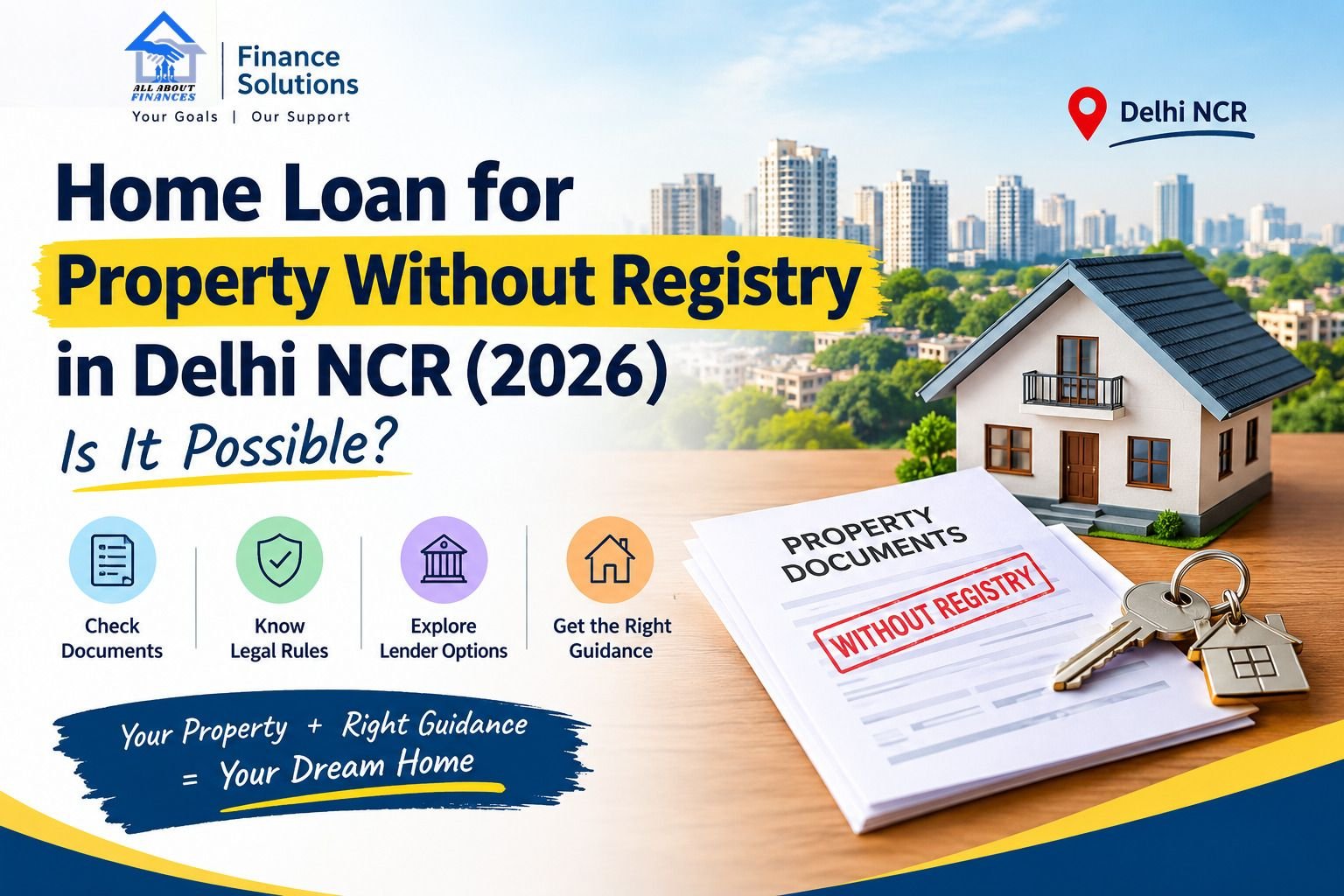
Home Loan for Property Without Registry in Delhi NCR (2026): Is It Possible?
Introduction
Buying a property in Delhi NCR can sometimes involve properties where the buyer has documents such as an Agreement to Sell, GPA, Will, possession letter, allotment letter or other ownership-related papers, but does not have a registered sale deed or conveyance deed.
This often creates an important question:
Can you get a home loan for property without registry in Delhi NCR?
The short answer is: in most normal home-loan cases, getting finance becomes difficult when the property does not have clear and legally acceptable title documents. However, the exact possibility depends on the property’s legal status, ownership chain, location, type of documents available and the lender’s internal legal and technical assessment.
Delhi’s official property-registration information states that sale/conveyance documents are among the documents requiring registration, and the Delhi Revenue Department also explains that immovable property is lawfully transferred through a registered conveyance deed such as a sale or gift deed.
Therefore, before applying for a home loan without registry in Delhi NCR, it is important to understand what “without registry” actually means in your particular case.
What Does “Property Without Registry” Mean?
The term “property without registry” can mean different things.
For example, a property owner may have:
- Agreement to Sell
- General Power of Attorney (GPA)
- Special Power of Attorney (SPA)
- Will
- Possession Letter
- Allotment Letter
- Previous ownership documents
- Builder documents
- Mutation or property-tax records
- Other supporting property papers
However, having some property-related documents does not necessarily mean that the person has a registered title that a lender can readily accept as security.
This distinction is extremely important when applying for a home loan.
Can You Get a Home Loan for Property Without Registry in Delhi NCR?
Generally, It Is Difficult
For a standard home loan, the lender generally needs to establish that:
- The borrower has or will acquire a legally acceptable interest in the property.
- The property’s title is clear enough for the lender’s legal team.
- The property can be validly mortgaged.
- The ownership chain can be verified.
- There are no unacceptable disputes or encumbrances.
- The property meets the lender’s technical and legal requirements.
If the property does not have proper registered ownership documentation, the lender may not be comfortable accepting it as security.
Delhi’s official guidance states that certain immovable-property documents, including sale and conveyance documents, are compulsorily registrable.
This is one of the reasons why a property without proper registry can face difficulty during a home-loan legal verification.
Why Is Registry Important for a Home Loan?
1. Proof of Legal Ownership
A registered conveyance or sale deed is an important part of establishing ownership and the transfer of title.
An agreement to sell by itself does not generally operate as a conveyance of ownership. Delhi government material also states that an agreement to sell, GPA, SPA or Will by themselves do not convey title in immovable property.
2. Mortgage Creation
A home loan is secured against the property.
Therefore, the lender needs to be satisfied that the borrower has a legally recognizable interest that can be used as security.
If ownership itself is unclear, creating enforceable security can become difficult.
3. Legal Verification
Before approving a property-backed loan, lenders can conduct legal and technical checks.
These may include:
- Ownership verification
- Title-chain verification
- Encumbrance checks
- Property-document verification
- Approved-plan checks where applicable
- Property valuation
- Existing loan/mortgage checks
- Local authority documentation
What Documents May Be Checked by the Lender?
Depending on the property and transaction, the lender may ask for documents such as:
Property Documents
- Registered Sale Deed
- Conveyance Deed
- Previous Sale Deeds
- Agreement to Sell
- Allotment Letter
- Possession Letter
- GPA/SPA, where relevant
- Mutation documents
- Property-tax documents
- Approved building plan, where applicable
- Completion/occupancy documents, where applicable
- Encumbrance-related documents
- Chain of title documents
Applicant Documents
- PAN Card
- Aadhaar/identity proof
- Address proof
- Income proof
- Salary slips for salaried applicants
- Bank statements
- Income Tax Returns, where applicable
- Form 16, where applicable
- Business/income documents for self-employed applicants
- Existing loan details
The exact list varies according to the lender, property type and applicant profile.
What If I Have GPA Instead of Registry?
This is one of the most common questions regarding property transactions in Delhi NCR.
A GPA is not automatically equivalent to a registered sale deed.
Delhi Government guidance specifically states that an immovable property cannot be lawfully transferred merely through a GPA, SPA, Will or agreement to sell; lawful transfer generally requires a registered conveyance such as a sale or gift deed, subject to the applicable legal framework and property-specific circumstances.
Therefore, if you are planning to purchase a property only on the basis of GPA-related documents and want a home loan, you should get the property legally reviewed before making any financial commitment.
What If I Have an Agreement to Sell?
An Agreement to Sell is an important transaction document, but it is generally not the same thing as a registered sale deed transferring ownership.
Delhi government material explains that an agreement to sell does not itself operate as a conveyance of immovable property.
Therefore, if the property has only an agreement to sell and no acceptable registered title document, a conventional home loan may become difficult.
The lender’s legal team will determine whether the available documentation provides sufficient evidence of title and whether the proposed mortgage can be legally created.
Can a Home Loan Be Available for Every Property in Delhi NCR?
No.
Even when a borrower has a strong income and good credit history, the property itself must satisfy the lender’s legal and technical requirements.
For example, lenders may examine:
- Property title
- Ownership chain
- Location
- Property type
- Construction status
- Approved plans
- Existing encumbrances
- Seller’s ownership
- Local authority permissions
- Marketability of the property
- Ability to create a valid mortgage
So, home-loan eligibility is not determined only by the borrower’s income or credit score.
What About Properties in Unauthorized or Unregularized Areas?
This requires additional caution.
Some Delhi NCR properties may have complicated documentation because of issues relating to:
- Unauthorized construction
- Land-use restrictions
- Missing approvals
- Unclear title
- Agricultural land
- Colony regularization
- Leasehold/freehold status
- Building-plan issues
- Pending litigation
- Multiple ownership claims
In such cases, the lender may require additional documentation or may decline the property after legal and technical verification.
The exact outcome depends on the property’s legal status and the lender’s policy.
What About Lal Dora or Similar Properties?
Lal Dora and other special-category properties can have documentation structures that differ from conventional registered residential properties.
This does not mean that every such property will automatically qualify or automatically be rejected for a home loan.
The lender may examine:
- Ownership documents
- Property records
- Possession evidence
- Land status
- Construction status
- Local authority requirements
- Title chain
- Mortgageability
Therefore, it is important to get the specific property checked rather than relying on a general assumption.
Can Loan Against Property Be Taken Without Registry?
A Loan Against Property (LAP) is also a secured loan, which means the lender needs acceptable rights over the property being offered as security.
Therefore, if ownership is unclear or the property cannot be legally mortgaged, obtaining a LAP can also become difficult.
However, the exact requirements vary between lenders and property types.
If you already own the property, it is useful to have the complete property-document set reviewed before applying.
What Can You Do If Your Property Has No Registry?
If you want financing for a property without registry, consider the following steps.
Step 1: Collect All Property Documents
Keep all available documents together, including:
- Agreement to Sell
- GPA/SPA
- Previous deeds
- Allotment papers
- Possession documents
- Mutation records
- Property-tax receipts
- Builder documents
- Authority documents
- Any other ownership-related records
Step 2: Verify the Ownership Chain
The complete chain of ownership should be examined.
A break in the title chain can create problems during lender verification.
Step 3: Check for Encumbrances
It is important to determine whether the property is already mortgaged, disputed or subject to another legal claim.
Delhi’s Revenue Department provides information regarding non-encumbrance certificates and the documents used for establishing ownership and checking encumbrances.
Step 4: Get Legal Verification
A qualified property lawyer can review the documents and identify potential title or transfer issues.
Step 5: Approach the Right Lender
Different lenders can have different property-document policies.
The final decision is generally based on the lender’s legal, technical and credit assessment.
What Are the Alternatives If a Home Loan Is Not Possible?
If the property does not qualify for a conventional home loan, some alternatives may be considered depending on the circumstances.
1. Complete the Property Registration
If legally possible, completing the required registration and documentation can make the property’s title position clearer.
2. Choose a Property With Clear Title
Purchasing a property with a properly documented title can simplify the financing process.
3. Consider Other Secured Finance Options
Depending on your circumstances, other forms of secured finance may be available, subject to lender policies and property eligibility.
4. Check Another Lender
Different lenders may have different policies, but this should not be interpreted as a guarantee that another lender will approve a property with incomplete title documents.
Home Loan Without Registry: Documents Checklist
Before approaching a lender, prepare the following checklist:
| Document | Why It May Be Required |
|---|---|
| Registered Sale Deed | Evidence of ownership/transfer |
| Previous Title Documents | To establish ownership chain |
| Agreement to Sell | Details of proposed transaction |
| GPA/SPA | Supporting document where applicable |
| Allotment Letter | Evidence of allotment |
| Possession Letter | Evidence relating to possession |
| Mutation Documents | Supporting revenue record |
| Property Tax Records | Supporting property information |
| Approved Plan | Construction verification |
| Encumbrance Documents | Check existing claims/charges |
| Identity Proof | Applicant verification |
| Income Proof | Loan eligibility |
| Bank Statements | Financial assessment |
| ITR/Form 16 | Income verification where applicable |
Note: The actual documentation requirement depends on the property, location, transaction and lender.
How Lenders Usually Evaluate Such Properties
A lender’s assessment can broadly be divided into three areas.
Legal Verification
The legal team may examine:
- Title
- Ownership
- Previous transactions
- Encumbrances
- Litigation
- Transferability
- Mortgageability
Technical Verification
A technical assessment may examine:
- Property location
- Construction
- Layout
- Area
- Building condition
- Approved plans
- Market value
Financial & Credit Assessment
The lender may also evaluate:
- Income
- Employment/business profile
- Credit history
- Existing liabilities
- Repayment capacity
- Loan amount requested
All three areas can affect the final loan decision.
Home Loan for Property Without Registry in Delhi NCR: Key Points
Before applying, remember these points:
- A property without a registered title document can be difficult to finance.
- GPA is not automatically the same as a registered sale deed.
- Agreement to Sell does not by itself generally transfer ownership.
- Property title and mortgageability are important for secured home loans.
- A strong CIBIL/credit profile alone does not guarantee property approval.
- Every property should undergo legal and technical verification.
- Requirements can differ between lenders.
- Do not pay a large token amount before checking the property’s legal documentation.
- Take professional legal advice where the title structure is complicated.
Frequently Asked Questions (FAQs)
1. Can I get a home loan for property without registry in Delhi NCR?
It can be difficult. A lender generally needs satisfactory legal title and acceptable security documentation. The final decision depends on the property’s documents, legal status and the lender’s policy.
2. Can I get a home loan on GPA property?
A GPA alone is generally not treated as equivalent to a registered sale deed for transfer of ownership. The lender may require legally acceptable title documents before considering the property for a home loan.
3. Can I get a home loan with only an Agreement to Sell?
An Agreement to Sell generally does not itself convey ownership like a registered sale deed. Therefore, a home loan may be difficult if acceptable title documentation is not available.
4. Is registry compulsory for a home loan?
For most conventional property purchases financed through a home loan, the lender will require legally acceptable ownership/title documentation and the ability to create valid security. The exact requirements depend on the property and lender.
5. Can I get a loan for an unregistered property?
It depends on what “unregistered” means and what documents are available. If the property lacks legally acceptable title documentation, financing can be difficult.
6. Can a property without registry be used as collateral?
Not necessarily. The lender must be satisfied that the borrower has a legally enforceable interest in the property and that an acceptable mortgage/security can be created.
7. Does a good CIBIL score guarantee a home loan?
No. A good credit profile can support the borrower’s financial assessment, but the property must also satisfy the lender’s legal and technical requirements.
8. What should I do before buying a property without registry?
Get the property’s title documents reviewed by a qualified property lawyer, verify ownership and encumbrances, and confirm financing feasibility with the lender before making a major financial commitment.
Final Takeaway
A home loan for property without registry in Delhi NCR is not a simple yes-or-no matter.
The key question is not only whether the buyer has sufficient income or a good credit history. The lender also needs to determine whether the property has clear and legally acceptable title documentation and can be validly mortgaged.
If your property has only a GPA, Agreement to Sell, possession letter or other supporting documents, do not assume that these documents are automatically sufficient for a home loan.
The safest approach is to have the property documents legally verified and then check the financing options available for that specific property.
Need help understanding your home-loan eligibility?
Share your basic property and loan details with us to understand the documentation and financing options that may apply to your case.
Disclaimer
This article is for general informational and educational purposes only and should not be treated as legal, financial or lending advice. Property laws, registration requirements and lender policies may vary depending on the property, location, documents and individual circumstances. Always verify the latest requirements with the concerned government authority, lender and a qualified property/legal professional before making a property or loan decision.
Latest Blogs
- Home Loan for Property Without Registry in Delhi NCR (2026): Is It Possible?
- Home Loan for Lal Dora Property in Delhi NCR (2026)
- Home Loan Without Approved Building Plan in Delhi NCR (2026)
- Home Loan for PM-UDAY Properties in Delhi: Complete Guide
- Home Loan Sanction Letter: Meaning, Format, Validity & Importance